Charging stations in the workplace: what are the safety obligations in case of fire?
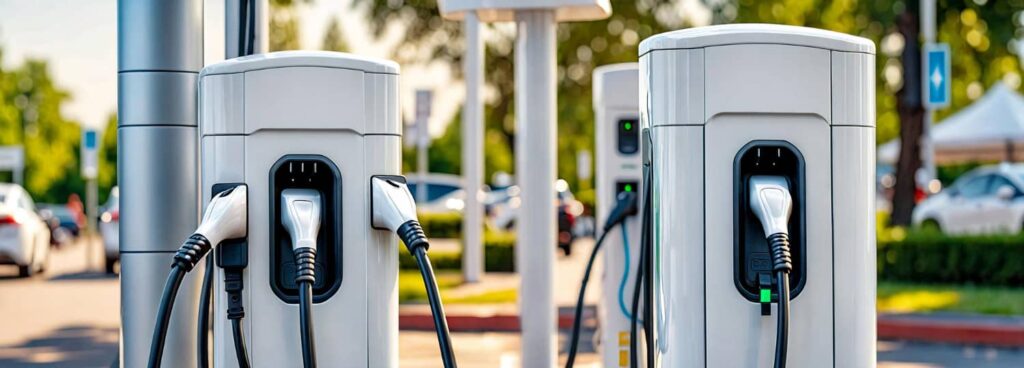
The electrification of fleets and usage patterns is rapidly transforming business premises. Company parking lots, warehouses, and industrial or commercial sites are being equipped with charging stations for electric vehicles.
However, this evolution is accompanied by a specific fire risk, which many companies are still poorly anticipating.
Between legal responsibilities, insurer requirements and the complexity of fires related to lithium-ion batteries, the question is no longer whether to act, but how to effectively secure charging stations in companies.
Charging stations and lithium-ion batteries: a new risk for businesses
Generalization of charging stations on professional sites
Charging stations are no longer limited to public parking lots. They are becoming standard equipment on company premises, for several reasons:
- Fleets of electric vehicles : company cars, utility vehicles, service vehicles.
- Terminals for employees and visitors, often accessible over long periods of time.
- Growing obligations in the service and industrial sectors, related to CSR policies, environmental regulations and calls for tenders.
This multiplication of charging points mechanically increases exposure to risk, particularly on sites not initially designed for this type of equipment.
Charging lithium-ion batteries: a high-risk phase
Unlike a stationary internal combustion engine vehicle, an electric vehicle under load goes through a phase of maximum battery stress:
- Increase in internal temperature,
- Risks related to charging faults or damaged cells,
- Possibility of thermal runaway, a sudden and self-sustaining phenomenon.
Charging is now recognized as the most critical moment in the life cycle of a lithium-ion battery.
Why businesses are now on the front line
By installing and operating charging stations, the company becomes responsible for safety:
- The site operator is responsible, even if the vehicle belongs to an employee or a third party.
- Presence of employees, visitors and service providers, with an obligation to protect people.
Major insurance and legal issues in the event of a claim (material damage, business interruption, liability issues).
What are the fire risks associated with charging stations in the workplace?
Thermal runaway during charging
Thermal runaway in a lithium-ion battery can occur without any clear warning signs:
- Uncontrolled internal overheating,
- Extremely rapid fire spread.
- Releasing a large amount of energy in a very short time.
These fires are difficult to anticipate and control, even with conventional detection systems.
Rapid spread of fire in parking lots and buildings
In a professional environment, the consequences are often aggravated:
- Domino effect between vehicles parked nearby,
- Propagation to the building structures,
- Increased vulnerability of enclosed or semi-enclosed car parks, where heat and fumes accumulate.
A localized fire can quickly become a major disaster.
Toxic fumes and collateral damage
Lithium-ion batteries release the following during a fire:
- Highly toxic and corrosive fumes,
- Gases that are dangerous to people,
- Residues that can cause lasting damage to equipment, networks and structures.
Even without total destruction, indirect damage can render a site unusable for weeks or months.
What does the regulation say about fire safety for charging stations in businesses?
Charging stations: a regulatory framework that is still evolving
À ce jour, il n’existe pas de réglementation incendie unique et totalement spécifique aux bornes de recharge en entreprise. Le cadre repose sur :
- Des normes électriques existantes,
- Des règles de sécurité incendie générales applicables aux bâtiments,
- Des recommandations issues de retours d’expérience.
Cette situation crée des zones grises réglementaires, souvent interprétées a posteriori, après sinistre.
Responsibilities of the employer and the site operator
In the absence of highly specific rules, the principle is clear:
the company has an obligation to guarantee a specific outcome regarding:
- The protection of people,
- The protection of property,
- Business continuity.
Failing to anticipate a known risk can be considered a breach of this obligation.

What authorities and insurers are increasingly demanding
In reality, the requirements are increasing:
- Formalized risk analysis related to charging stations,
- Implementation of measures to prevent and limit the consequences,
- Justification of technical choices in the event of a disaster.
Insurers often become the primary prescribers in matters of fire safety.
Parkings d’entreprise : les zones les plus exposées en cas d’incendie
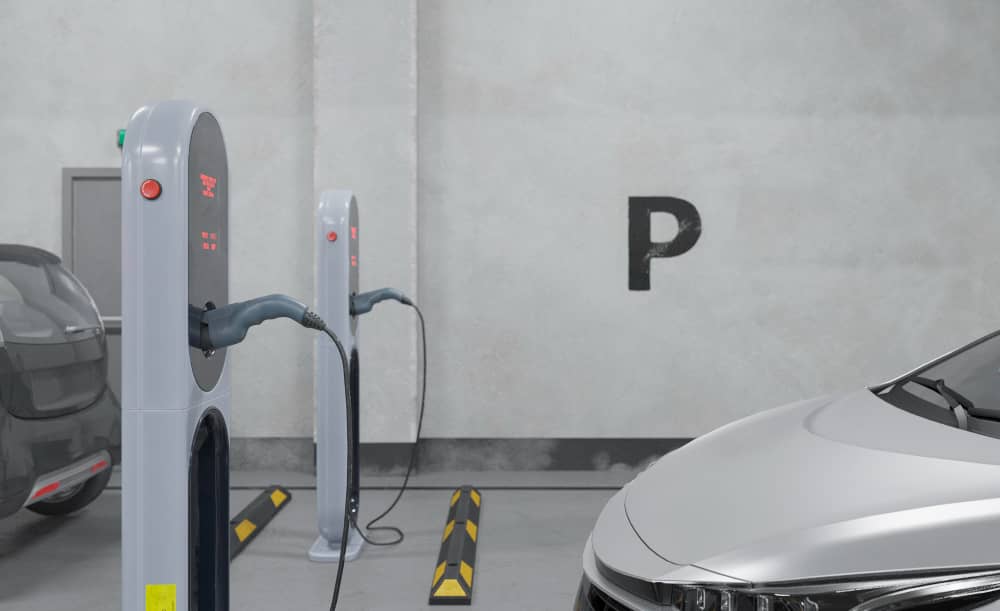
Underground and semi-enclosed parking lots
These are the most critical environments:
- Ventilation is often insufficient in the face of a battery fire.
- Rapid accumulation of heat and toxic fumes,
- Difficulty accessing and intervening for emergency services.
A fire breaking out in these areas could lead to the total closure of the site.
Outdoor parking and logistics areas
Even outdoors, the risk does not disappear:
- Immediate proximity to the buildings,
- Presence of docks, stocks or sensitive equipment,
- Risk of propagation to infrastructure.
The placement of the charging stations is therefore strategic.
Terminals accessible to the public or employees: an aggravating factor
When the terminals are accessible to many users:
- Increased charging cycles,
- Vehicles of unknown condition (aging or damaged batteries),
- Less control over actual usage.
This significantly increases the overall risk level.
What are the fire prevention obligations for businesses?
Identify and assess the risks associated with charging stations
Any serious undertaking begins with:
- A precise map of the risk areas,
- Environmental analysis (parking, building, human traffic),
- Taking into account battery types and charging power.
This step determines all subsequent measures.
Implement appropriate protective measures
Prevention is not limited to detection:
- Physical separation of charging areas,
- Solutions for containing a fire as soon as it starts,
- Devices designed to limit the spread of fire and smoke.
The goal is to save time and reduce the impact.
Train and inform the teams
A technical system without a human element is incomplete:
- Training in how to react in the event of an incident,
- Clear and well-known emergency procedures,
- Coordination with emergency services.
Speed of reaction is crucial.
Why insurance companies are imposing new requirements on businesses
Increase in claims related to electric vehicles
Insurers note :
- An increase in fires involving lithium-ion batteries,
- Very high damage costs
- Site downtimes incompatible with certain activities.
Difficulties in extinguishing lithium-ion battery fires
Battery fires pose specific problems:
- Fires could reignite several hours after extinguishing.
- Large volumes of water are needed.
- Conventional methods of extinguishing fires are often insufficient.
This profoundly changes risk management.
Consequences for insurance contracts
In practical terms, this translates to :
- Higher deductibles,
- Specific clauses regarding charging zones,
- Exclusions may occur in the absence of appropriate measures.
The reinsurability of the site is becoming a central issue.